

The Problem
LSP is an openly published facilitation method, licensed under Creative Commons, that historically required everyone in the same room with a box of bricks. Once teams went remote that constraint stopped being fundable: flying people in to build with physical bricks was impractical and upper management would not pay for it. Generic collaborative whiteboards do not solve this, because they understand canvases and not the method. They give a facilitator an open surface with no five-stage structure, no stage state machine, no breakout composition, and no discipline. Bolting an AI button onto a whiteboard fails for the same reason: it adds a feature to the wrong substrate instead of encoding the sequence that makes the method work.
The Approach
The five LSP stages run as the spine of every session, not as templates you can skip: skill building, individual model, shared model, system model, guiding principles. A facilitator controls each stage live, moving the whole room forward, pausing, extending or resetting, with everyone on one shared countdown.
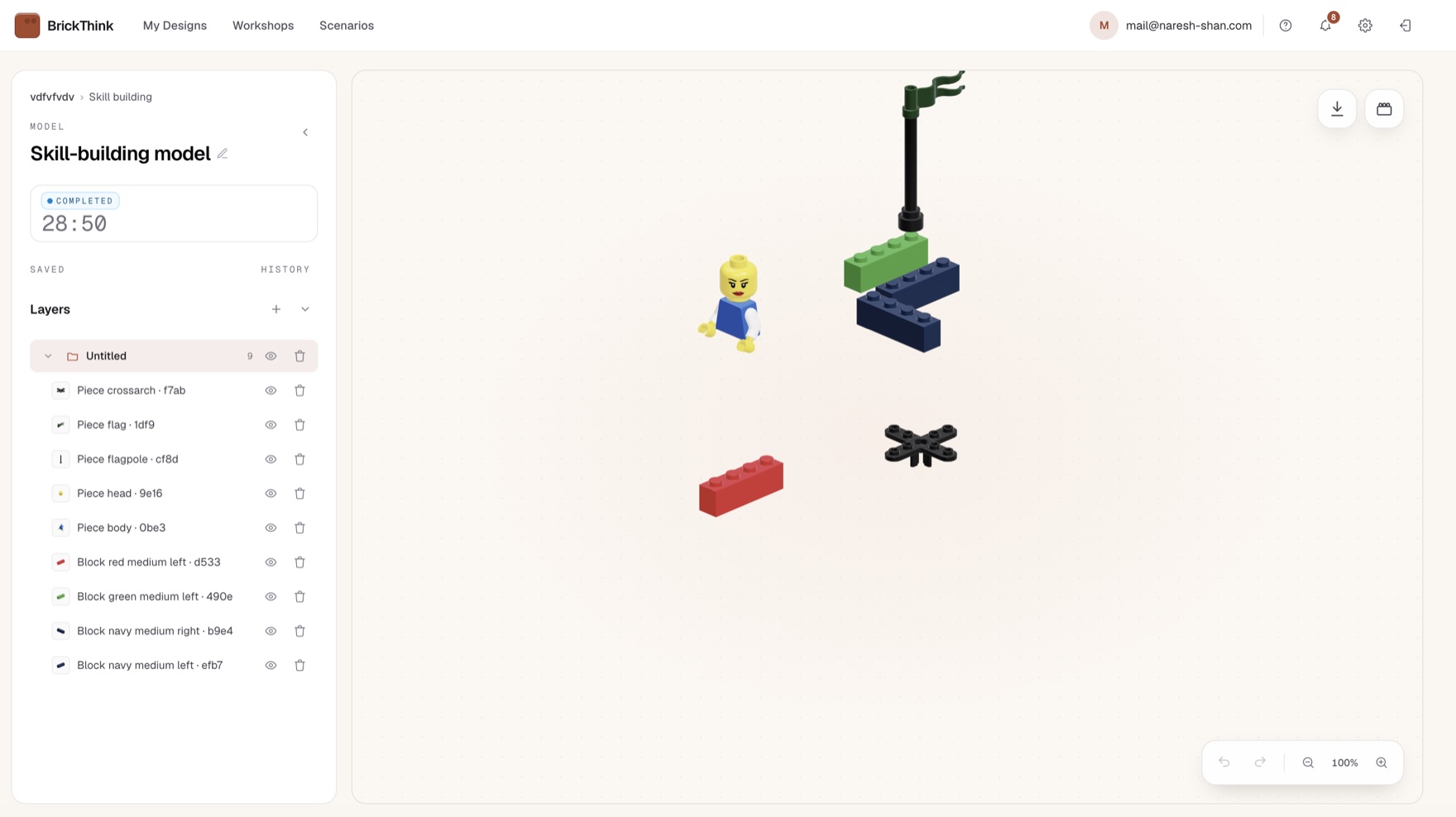
Participants build on a 2D canvas using a custom brick set of 58 pieces across seven categories, dragging, scaling, rotating and grouping as they go. The bricks are original artwork. The product carries the method without carrying the trademark.
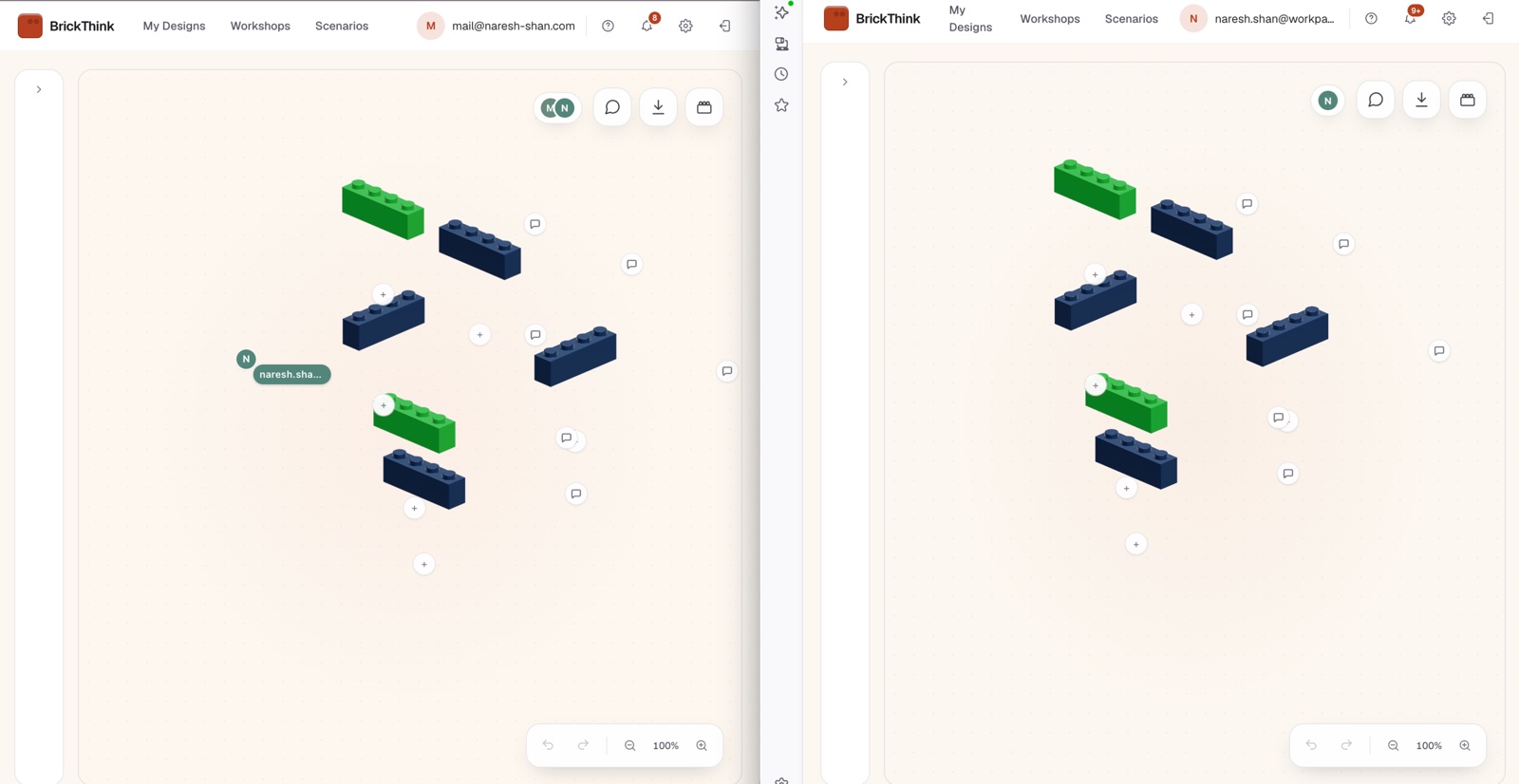
Everyone works together in real time. Live cursors, presence, undo and redo, reactions on individual bricks, and threaded comments. Breakout rooms pull each person's individual model into labelled lanes for the shared and system stages, so consensus has somewhere to form.
Twenty ready-made scenario templates cover every stage, with facilitator overrides. A facilitator can run a full session without writing anything from scratch.
AI turns each workshop into a branded PDF report. The build moved from every facilitator supplying their own AI key to a single managed key on the platform, shifting that cost onto the product and removing setup for the user.
Outcomes
- Shipped a stable 1.0 production release of the full five-stage LSP platform
- Built and deployed the entire stack solo: Next.js 15, React 19, Supabase, Konva, Yjs, on Railway across separate web and worker services
- Custom 58-tile brick set across seven categories, with no LEGO trademark assets
- Library of 20 canonical scenario templates with per-stage assignment and overrides
- Real-time multi-participant editing on breakout-room canvases via Yjs CRDT, with live cursors, presence and per-brick comments
- AI-generated session report PDF pipeline, moved onto a single managed server key
- Three-tier billing system wired end to end through Stripe Checkout, Customer Portal and a webhook as the sole writer of entitlement state
- White-label report pipeline rendering the PDF in a facilitator's own logo, colours and fonts
- WCAG 2.2 AA accessibility pass: keyboard canvas, colourblind pattern mode, screen-reader brick mirror
What I Learned
Three lessons from rebuilding the business model, in the order they landed.
Open source funds nothing
Open source funds nothing on its own. I shipped free forever with billing torn out of the codebase, and that position survived right up until a single-operator service had to absorb the AI cost of every report it generated. Conviction does not cover an API bill.
What to charge for is the hard part
Charging is not the hard part. Choosing what to charge for is. This audience guards the method and treats any tool that monetises an openly licensed methodology as extraction, so the software and the method had to stay free while the cost-recovery sat on optional managed AI services a user can avoid by self-hosting or bringing their own key.
A positioning promise is debt
The reversal had to be loud, not quiet. The original copy committed to announcing any move away from free, which meant the FAQ, investor answers, press release and changelog all became debt the moment billing shipped. A positioning promise is a maintenance burden, not a one-time statement.
LEGO®, SERIOUS PLAY®, the Minifigure and the Brick and Knob configurations are trademarks of the LEGO Group, which does not sponsor, authorize or endorse this product.