
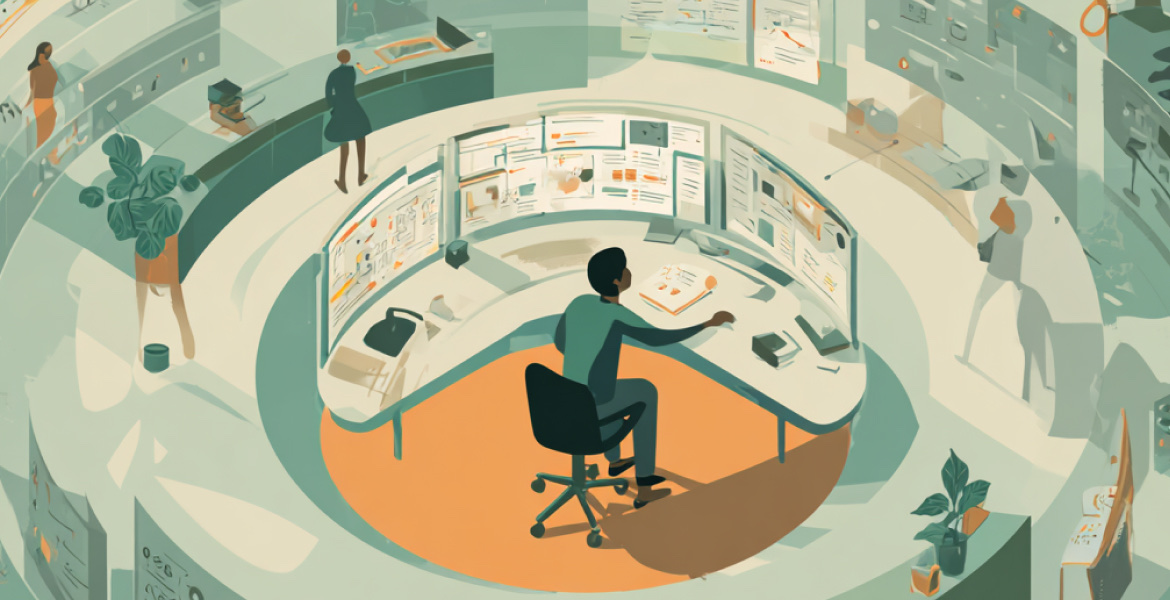
There is a kind of burnout that does not come with a dramatic exit. It does not surface in a meeting or a performance review. It builds slowly, in the space between what the role was supposed to be and what it has quietly become.
The lone designer on a cross-functional team knows this pattern well.
They joined to do meaningful product work. Within a few months, they are running every piece of design work for a squad of eight to fifteen engineers. They are the only person asking user questions, the only one thinking about interaction patterns, the only one pushing back when the product manager describes a feature that would confuse the people who will actually use it. They are doing everything because there is no one else to do it.
This is not an accident. It is a structural outcome that organisations have been building toward for years.
The Ratios Were Always Going to Fail
Nielsen Norman Group's staffing research puts the typical researcher-to-designer-to-developer ratio at 1:5:50. In squad-based organisations, the ratio often looks worse in practice: one designer embedded across a product team of eight to twelve engineers, with no dedicated researcher and no design lead with actual bandwidth to support them.
Peter Merholz, author of Org Design for Design Orgs, has documented the consequences of this model in detail. When a designer is embedded alone into a cross-functional squad, organisations are asking a single person to deliver across an unrealistic range of capabilities: interaction design, visual design, content, user research, strategy, facilitation, stakeholder communication, and often, production-level execution at the same time.
Senior designers end up doing work far below their level because no one else is available to do it. Junior designers, without mentorship or peers, function effectively as production artists executing a product manager's specifications.
The pipeline collapses. Senior designers burn out and leave. Junior designers never develop. And the organisation keeps hiring for the mythical unicorn designer who can do it all, alone, indefinitely.
Optimised for Engineering Throughput
Cross-functional teams are optimised for engineering throughput. Sprints are set, tickets are written, and velocity is measured in shipped features. Design is expected to slot in around this cadence, delivering ahead of the engineering queue while also attending every planning session, every standup, and every stakeholder review.
The designer is, by default, the only person in the room who represents user thinking. That is not a small job. But because it has no equivalent in the engineering world, it is often invisible. There is no sprint point for "challenged a feature direction that would have created a confusing flow." There is no metric for the bad path that did not get built.
Memorisely's Burnout Curve analysis captures what happens next. After layoffs and team restructures, senior designers are left to cover every gap: research, strategy, prototyping, visual delivery, facilitation, mentoring, and sometimes even writing production copy or contributing to code. The breadth of responsibility does not plateau. It grows as the team contracts.
Isolation Is Structural, Not Personal
Gallup research puts 77% of employees at elevated burnout risk when they feel isolated. Being the only person in your discipline on a team is a structural form of isolation. There is no peer to pressure-test a decision with. No colleague who understands the trade-offs you navigated last week. No one who notices when the quality of your work is starting to slip because you are running at capacity and have been for months.
Output Is Not Capacity
The most common mistake organisations make with lone designers is mistaking sustained output for sustainable capacity.
A designer who is producing work week after week looks fine from the outside. Tickets are being closed. Designs are being shipped. The machine is running. What is not visible is the cost of that output: the strategic work being deferred, the research that is not happening, the design debt accumulating because there is no time to revisit anything that shipped six months ago.
By the time burnout becomes visible, the designer has already decided to leave. The organisation then spends three to six months' salary replacing them, drops the problem back into the same structural conditions, and wonders why the new hire starts showing the same signs within a year.
What a Lone Designer Can Do
This is a systemic problem, but it lands on individuals. If you are a lone designer on a cross-functional team, the most important thing you can do is make your capacity visible before it runs out.
Document the scope of what you are doing. Not just the deliverables but the decisions, the unplanned requests, the work that never makes it into a ticket. Make this visible to your manager regularly. Not as a complaint, but as data. Organisations respond to data.
Set explicit boundaries around research and strategy time. If every hour is reactive, you are functioning as a production resource, not a designer. Those hours need to be scheduled and protected the same way engineering sprint capacity is.
Find external community. The isolation of being the only designer on a team is real. Design communities, peer groups, and mentorship networks do not fix the structural problem, but they close the peer gap enough to protect your thinking and your sanity.
Be honest with yourself about the trajectory. If the scope keeps expanding and the support does not, the situation is not going to improve on its own. That is not pessimism. It is pattern recognition.
The Answer Is Organisational Design
None of this is solved by better self-care. The answer is not yoga or time management. It is organisational design.
Merholz argues that the team, not the individual designer, is the atomic unit of a design organisation. Designers need peers, mentors, craft community, and a shared identity beyond the squad they sit in. The embedded model has real advantages for collaboration and shipping velocity. But without a design discipline structure that supports people inside it, the model consumes its own practitioners.
The lone designer always burns out first because the conditions produce exactly that outcome. Until organisations redesign those conditions, the pattern will keep repeating.