
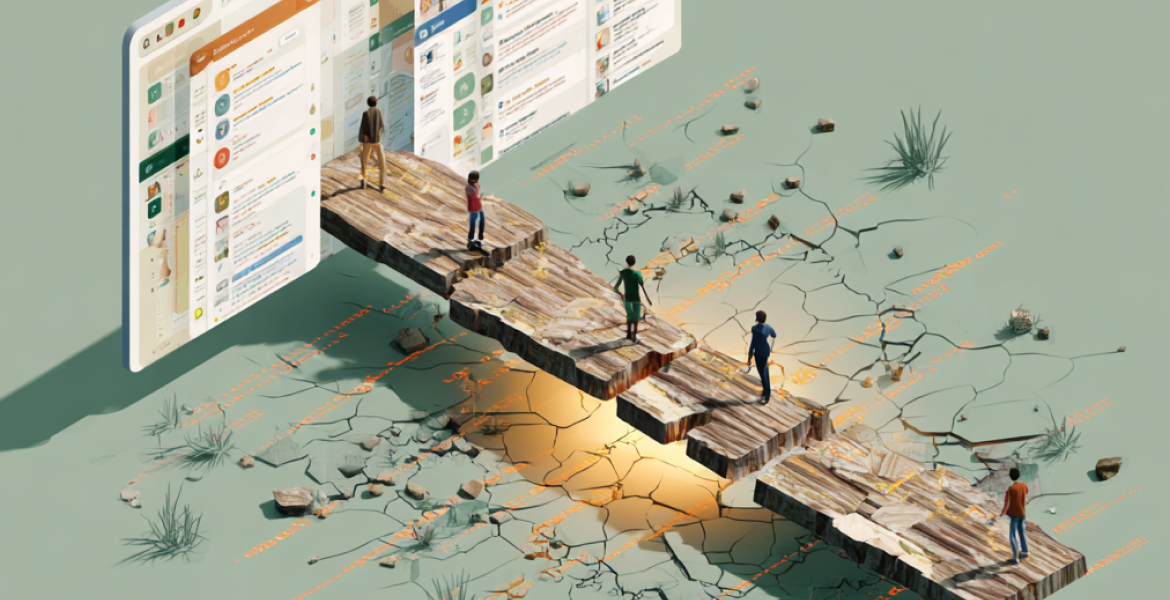
You opened the production build. You compared it to the Figma file. Something shifted. The spacing is wrong, the type hierarchy collapsed, the interaction you spec'd three sprints ago got quietly dropped. You feel the familiar sting: "They didn't build what I designed."
You are not alone. In Anima's survey of UX/UI designers, team collaboration during the design-to-development handoff ranked as the single most common frustration. Designers reported losing control of the end product, watching carefully considered decisions dissolve between Figma and the browser. The handoff, despite a decade of tooling improvements, remains broken.
But the instinct to blame a single role misses the structural reality. The gap between your Figma file and the shipped product is not one person's failure. It is a system-level breakdown with predictable causes and, more importantly, fixable architecture.
The Control-Accountability Imbalance
Erica Rider, UX Lead at PayPal, named the core dysfunction precisely: designers have zero control over the UX delivered to users but carry 100% of the accountability, while engineers have zero accountability for UX delivered to users but hold 100% of the control. That imbalance is not a personality clash. It is a structural defect baked into how most product organisations assign ownership.
When a product ships with degraded fidelity, the designer gets the questions. Why does it look different? Why didn't you catch this? But the designer was never in the room when the engineer made a pragmatic trade-off under sprint pressure. And the engineer was never in the room when the designer made a deliberate spacing decision informed by user testing. Both operated rationally within their own constraints. The system failed to connect those constraints.
Three Roles, Three Rational Failures
Designers spec in isolation. The Figma file captures intent, but intent without implementation context is a wish list. A comprehensive review published on arXiv found that many design concepts fail to account for technological limitations, forcing developers to modify designs unilaterally. When the spec does not anticipate API latency, responsive edge cases, or component library constraints, developers fill the gaps with their own judgment. They are not ignoring the design. They are solving problems the design did not address.
Developers build in isolation. The code ships without a fidelity review against the original design because no one scheduled one. Poor communication and unclear requirements cause up to 30% of development delays. When the engineer does not flag a deviation, it is rarely malice. It is a workflow that never created a checkpoint for visual parity.
Product managers scope in isolation. The PM cut a feature mid-sprint but never updated the design file. Or they approved a "fast follow" compromise that quietly became permanent. The PM is accountable for positively impacting the business, not for producing hundreds of features. When fidelity gets traded for velocity, the PM made a rational business decision. But they made it without the designer in the room.
The Tooling Illusion
Figma's Dev Mode, Zeplin, design tokens, auto-generated specs. The tooling has never been better. And yet the problem persists. The Zeroheight Design Systems Report 2025 found that while 84% of teams have adopted design tokens, resource shortages and communication breakdowns remain the dominant roadblocks. The Sparkbox Design Systems Survey showed that 52% of organisations cite adoption difficulties as the primary reason their design systems are unsuccessful.
Tools solve information transfer. They do not solve shared understanding. A static file, no matter how high-fidelity, is a dead document the second it is "handed off." The word "handoff" itself reveals the problem: it implies one party stops and another starts. No shared ownership. No overlapping accountability. Just a file thrown over a wall with better formatting.
What Actually Fixes It
The fix is not another plugin. It is restructured accountability.
First, kill the handoff. Replace it with continuous co-authorship. Airbnb's Design Language System cut handoff time by 34% and reduced design inconsistencies by 68% not through better specs, but by making designers and engineers co-owners of the same component system. IBM embedded Design Thinking across departments so that designers and developers work together from ideation to delivery. The pattern is consistent: teams that eliminate sequential handoffs and create overlapping ownership produce higher fidelity products.
Second, make fidelity a shared KPI. If only the designer notices when spacing is wrong, only the designer will care. Leading teams align metrics across roles so that both designers and engineers are accountable for product quality, not just their isolated contributions.
Third, schedule fidelity checkpoints. Not at the end. During. Joint design-dev sessions before any Figma frame or commit. Pair reviews at the component level, not the page level. The organisations that close the gap do not rely on a final QA pass. They build comparison into the daily workflow.
Whose Fault It Actually Is
No one's. And everyone's. The shipped product looks different from the Figma file because the system that connects design intent to engineering execution has structural gaps. Designers spec without implementation constraints. Engineers build without fidelity checkpoints. PMs trade visual quality for velocity without surfacing the trade-off.
The frustration is valid. The blame is misplaced. The fix is not working harder within a broken system. It is redesigning the system itself: shared ownership, overlapping accountability, and continuous co-authorship from the first frame to the final deploy.
Your Figma file is not the product. The product is what you build together.